Announcing our $35m fundraise! Read all about it here

Automated root cause analysis that runs in your cloud.

You are in a cost review meeting and someone points out that your observability bill now exceeds your compute spend. The pipeline is treated as plumbing, so data gets pushed downstream with no filtering, no enrichment, and no governance. Every problem gets discovered too late to fix cheaply. Tsuga treats the pipeline as a first-class feature. You filter, transform, and route telemetry before it hits storage, and you make that decision before the meter starts running.

Incident investigation that scales economically

Teams don't cut logs because they want to. They cut logs because their vendor made keeping them dangerous. Short retention windows, expensive fields and opaque pricing all push engineers toward the same decision, so the incentives run backwards.

Engineers spend their time staring at dashboards waiting for things to break, then taking the heat when they do. Observability bills grow three times in a year, which forces teams to shrink retention and sample logs. They miss the one event that mattered.

Here is how those compromises show up in incident response.

When something goes wrong, the first 20 minutes of every incident get swallowed by manual work. The person on call is not fixing the problem yet. They are still looking for it.

How Tsuga helps


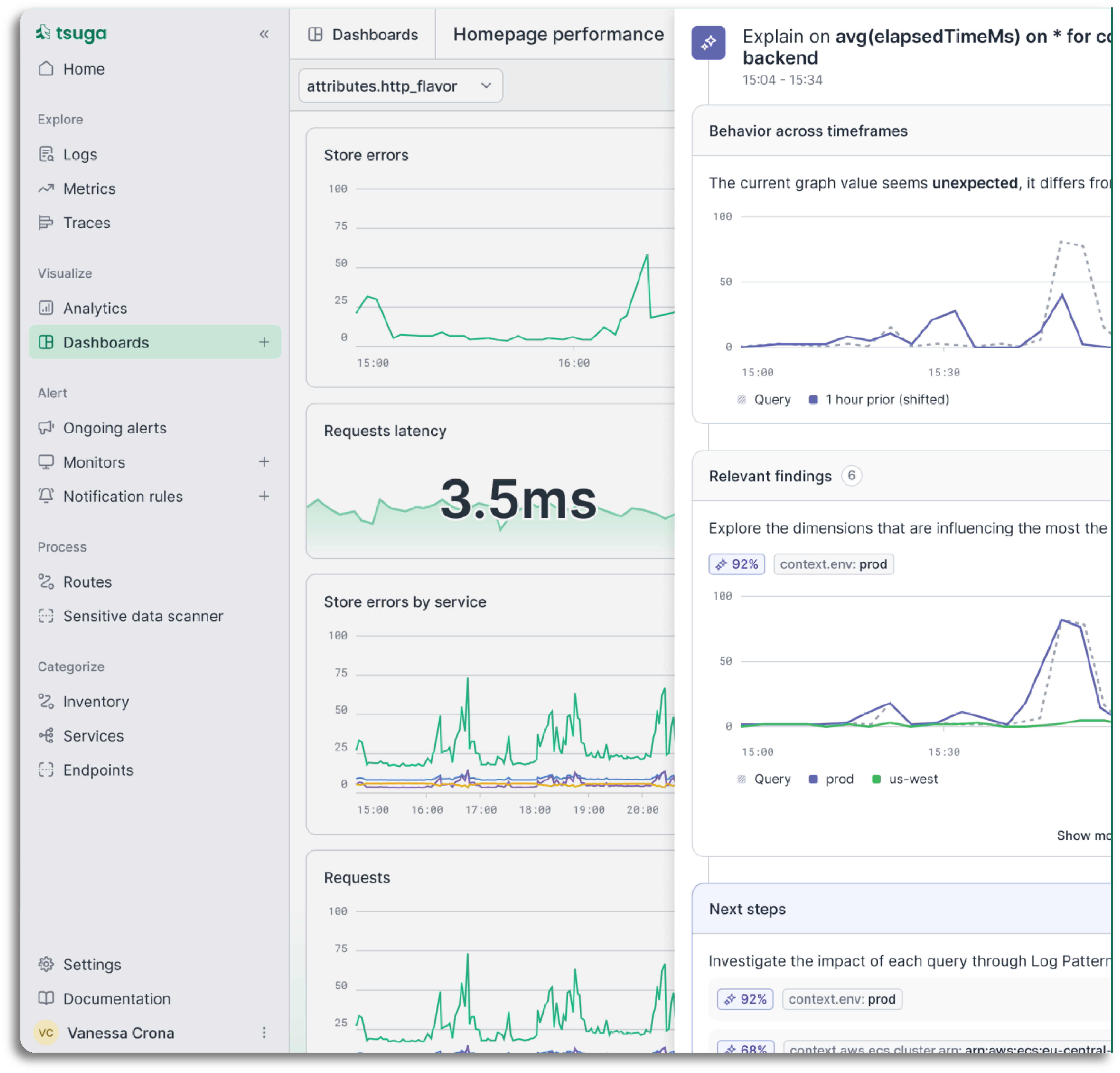
Automated root cause analysis scans hundreds of dimensions the moment a spike is detected and surfaces a plain-language explanation before your team opens the alert. The 20-minute investigation phase becomes a 10-second read.

Incident investigation that scales economically

Automated root cause analysis that keeps your data under your control

Tsuga deploys automated root cause analysis, anomaly detection, and deployment regression detection inside your AWS account via infrastructure as code in under two hours. Your telemetry stays in your cloud, under your KMS keys, in your own object storage.

Why Tsuga is different

Because we do not resell infrastructure or profit from data bloat, the incentives line up differently.

You pay for software, not a markup on your own infrastructure

Traditional platforms ingest your telemetry into their cloud, then charge you for accessing your own data. Storage and compute hit their bill, marked up and passed on to you. With Tsuga, the engine runs on your EC2 instances and writes to your S3 buckets. Those costs hit your AWS bill directly. We charge for the software layer we manage.

Your data never leaves your cloud

Telemetry contains source code, business logic, customer PII, and now LLM prompts. Shipping that to a third-party cloud creates real data sovereignty and residency risks. Tsuga deploys entirely inside your VPC. Your KMS keys encrypt the data. Your object storage holds it. Our control plane connects via mutual TLS to manage the software layer remotely, but it never ingests data directly.

A forward-deployed engineer who actively reduces your costs

Tsuga is software and a service, not just SaaS. Every account gets a named field engineer for the lifetime of the relationship, plus direct access to the CTO. That engineer works inside your environment to optimise pipelines, retention policies, and access patterns. Because we do not profit from your infrastructure spend, their incentive is to make you run more efficiently, not to sell you more storage.

How it works/capabilities

Automated root cause analysis

The system scans hundreds of dimensions the moment a spike appears, isolates the smallest subset of signals that explains the behaviour, and surfaces a plain-language explanation with the relevant log and trace context attached.

Dynamic anomaly detection

The system learns historical patterns per service, endpoint, and environment. It alerts only when behaviour genuinely deviates from the learned baseline, and flags newly appearing errors that have no prior baseline the first time they show up.

Deployment regression detection

Tsuga watches every code deployment and continuously compares post-deploy telemetry against the pre-deploy baseline. It isolates regressions to the specific service version that introduced them and gives on-call engineers enough context to decide immediately whether to roll back.

Agent-scale query volume

The architecture handles the query volumes that autonomous agents generate when they investigate incidents, without rate limits or per-query charges. Your agents stay inside your cloud perimeter and all operational context remains under your control.

Open data formats and open storage

Team ownership, RBAC, audit logs, and cost attribution are native features. As application performance management usage grows across your organisation, governance scales with it. No retrofitted access controls or surprise billing lines.

Your telemetry lives in your S3 buckets in open formats. You can read, move, or build on your own data without any vendor, and connect it to your BI tools or agent frameworks via MCPs, CLIs, and APIs.

Sublinear cost scaling

Because storage and compute run on your own infrastructure, costs scale sublinearly as telemetry volume grows. There is no penalty for retaining data longer or querying it more frequently.

Is Tsuga right for you?

Tsuga is purpose-built for a specific set of constraints. If your situation does not match them, we will tell you upfront.

Tsuga is a fit if you...

  • Spend more than $100,000 per year on observability and see that figure growing faster than your infrastructure budget
  • Run large distributed systems where manual incident investigation takes 20 minutes or more before anyone forms a hypothesis
  • Are forced to sample logs, shrink retention windows, or drop entire regions to manage observability spend
  • Are scaling AI agents for incident response and need an observability backend that handles agent-scale query volumes without rate limits or runaway costs
  • Need data sovereignty, governance, or cost predictability (or all three)

Tsuga is not a fit if you...

  • Are a small team without significant observability spend or compliance requirements
  • Prefer a fully self-serve, no-touch product with no engineer engagement
  • Have no need for data residency controls and are not concerned about vendor lock-in

Frequently asked questions

Traditional alerting tells you that a metric crossed a threshold. It does not tell you why. Tsuga's automated root cause analysis identifies the specific dimensions, services, or deployments that explain the behaviour and presents that explanation alongside the relevant logs and traces.

Own your observability.

If your observability bill is growing faster than your infrastructure, or if telemetry leaving your cloud is a risk you cannot take, Tsuga is built for your constraints.