Lexicon · Guide
Observability costs: why your telemetry bill is eating your infrastructure budget
Why observability bills rise faster than infrastructure spend, what actually drives them, and how to get cost under control without giving up visibility.
Definition
Observability cost is what an organization pays to collect, move, store, index and query its telemetry, and it has grown from a line item attached to infrastructure into one of the fastest growing categories in cloud spend. The pattern is familiar enough to be boring: the systems are running, the teams are shipping, and the bill climbs anyway, quarter after quarter.
This guide covers what actually drives that growth, why so many organizations struggle to control it, and what changes when you treat it as an architecture problem rather than a procurement one. The short version is that most teams are not collecting too much telemetry, they are buying it on terms that charge them more for every year their systems get more complex.
Why the bill climbs
The uncomfortable answer is that observability costs behave exactly as the industry designed them to behave. Nothing below is a malfunction, which is why none of it responds to being managed harder.
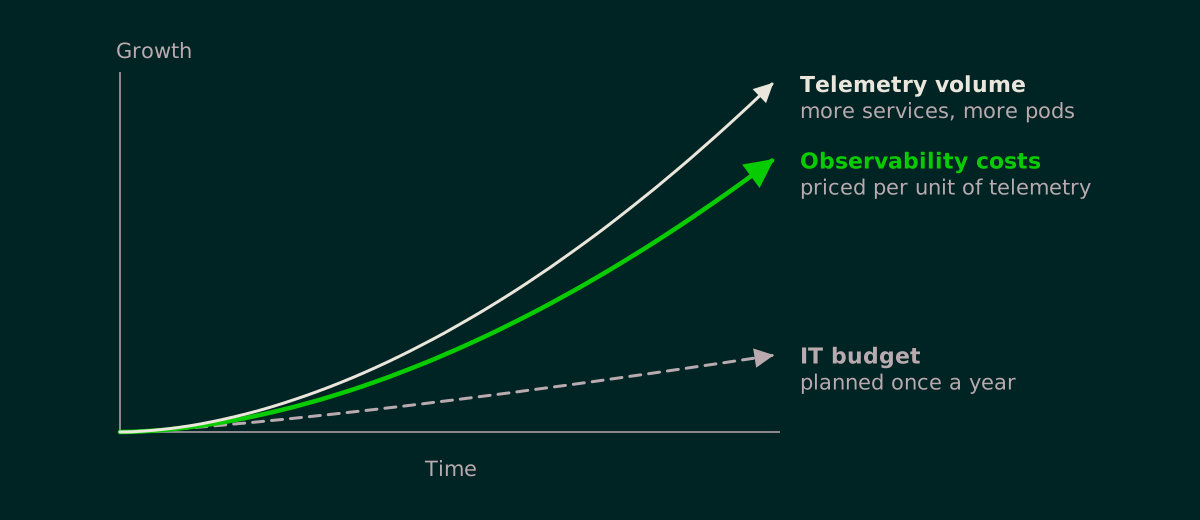
Telemetry grows faster than infrastructure
Every trend in software architecture increases telemetry generation. Microservices multiply service interactions, Kubernetes generates infrastructure events continuously, containers produce operational metadata by the pod, and AI workloads add entirely new streams of traces, logs and performance signals on top.
Because most vendors charge on the volume collected, processed or retained, that growth converts directly into spend. Telemetry volume grows by roughly thirty percent a year on its own, so the bill can rise by the same proportion while the organization changes nothing about how it works.
Pricing scales with complexity, not with value
Most platforms charge across several dimensions at once, separating infrastructure monitoring from application performance monitoring, log ingestion from log indexing, then adding custom metrics, database monitoring, synthetic testing and real user monitoring as their own lines. Each looks manageable alone, and together they produce a bill that is hard to predict and harder to control.
The deeper problem is what those dimensions reward. More detailed traces cost more, longer retention costs more, and richer metadata for investigations costs more, so the pricing model asks you to observe less precisely at exactly the moment you need to see more.
Logs get charged three times over
Logs earn their place, and during an incident they are frequently the evidence that identifies a root cause. What makes them expensive is not that they are measured by volume, it is that the same gigabyte is billed on ingestion, billed again to be indexed, and billed a third time to be retained.
Stacking those charges is what turns a log strategy into a budget line nobody can forecast. At scale you are paying three times over for enormous quantities of data nobody reads, while a small fraction of the logs drives most of the operational insight, and the platform gives you no way to price the two differently.
You pay to store the same data twice
Most platforms require telemetry to be copied out of your cloud environment and stored in vendor-controlled infrastructure, which means you pay your cloud provider to generate, process and retain operational data, then pay the vendor to ingest, store and query a second copy of it. Egress and transfer charges are usually collected along the way.
This duplication has become so normal that few teams question it. It is a permanent cost multiplier that grows in step with telemetry volume, and it is invisible on both invoices because neither one names it.
Sampling becomes a budget decision
For some workloads sampling is the right engineering call, and it stays right whatever it costs. The problem is what happens when costs become unsustainable and the rate gets set by the invoice instead, because logs get filtered, traces get dropped and retention windows shrink for reasons that have nothing to do with what the data is worth.
That version of the trade is worse than it looks, since it removes data before anyone knows whether it will matter. Teams end up paying more each year while trusting the platform less, and the tighter the budget gets the more aggressively the data is reduced, which makes each investigation harder than the last.
Who should own the budget
The platform engineering trap
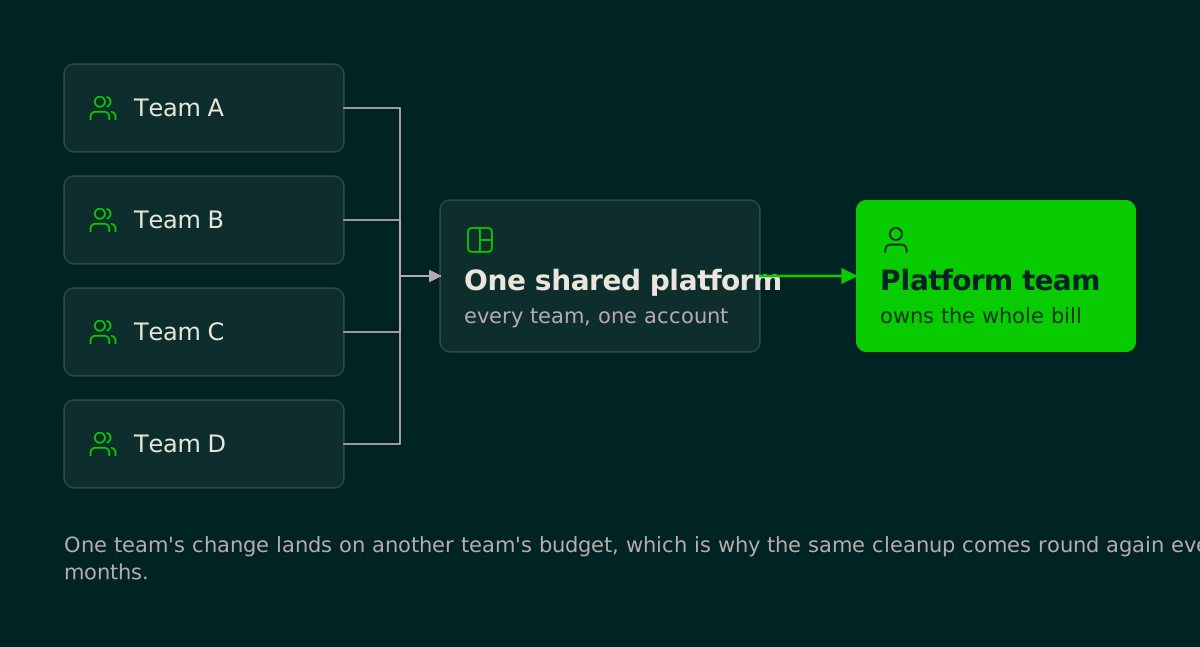
Observability is a shared resource in most organizations, where dozens of teams send telemetry into one platform and a single team is accountable for the bill. That arrangement makes costs hard to forecast, lets one team's change land on everyone else's budget, and turns platform engineers into telemetry janitors rather than reliability engineers.
It also repeats. A platform team cuts costs by removing unnecessary data, adjusting retention and tightening controls, then a few weeks later a service ships with verbose logging or high-cardinality tags and the bill is back where it started.
Move ownership closer to the source
This is the part FinOps gets right, which is that the people who influence spending should be able to see it, understand it and answer for it. Observability works the same way: every team should understand the cost impact of the telemetry it generates, every service should have an owner, and every significant source of spend should be attributable to a team, a product or a business function.
In practice that means a consistent tagging strategy, because without one, allocation is guesswork. At a minimum you should be able to answer which team generated a given stream of data, which service produced it, which environment it belongs to, and which version introduced the change.
Governance is what ties it together
The question is not whether platform engineering, finance or the development teams should own observability cost, because the answer is all three. Platform engineering sets the standards and guardrails, finance provides visibility and accountability, and engineering teams own the telemetry they generate.
What makes that work is a named owner with the authority to define telemetry standards, review cost trends and intervene when usage becomes unsustainable. Without that role the responsibility fragments and the costs keep rising with nobody accountable, which is why this has become a leadership question rather than a tooling one. The organizations managing it best are not the ones on the cheapest platform, they are the ones where ownership is clear and cost is something teams manage continuously rather than discover at the end of the month.
The cost problem is an opportunity to fix the tooling
Observability buying decisions used to be driven by features, with teams comparing dashboards, alerting, integrations and user experience while cost mattered but rarely decided. That has changed, and cost now leads the criteria for many buyers, which tells you organizations have stopped treating rising bills as a temporary annoyance and started treating them as structural.
That shift is healthy, because it forces better questions about the tools and about the incentives those tools create. A feature comparison never had to answer for what a platform charges you to keep looking.
Rising costs expose broken incentives
When a platform charges more every time you collect more, the rational response is to collect less. That is why so many teams end up shortening retention, sampling traces harder, filtering aggressively and stripping context out of telemetry to get the number down.
The distinction that matters is between intentional optimization and blind reduction. Dropping data you have examined and judged to be noise is good engineering, and a pipeline that lets you make that call before storage is worth having. Cutting until the number looks acceptable is something else, and the saving and the cost land in different places: a team saves thousands a month by filtering debug logs it never assessed, then discovers during an incident that the missing lines held the clue.
Consolidation alone does not fix it
Plenty of organizations see the problem and reach for consolidation, on the logic that if eight tools are expensive then three will be cheaper. It rarely works, because moving more workloads onto one platform does not change the pricing model underneath it.
The bill still grows with volume, retention and usage. Consolidation can be worth doing for other reasons, but it is not an answer to the economics.
Evaluate the architecture, not the feature list
The teams making real progress are asking a different set of questions. Where does the data live, how does cost scale as telemetry grows, can we query our own data without vendor-specific tooling, and can we keep complete datasets without relying on sampling.
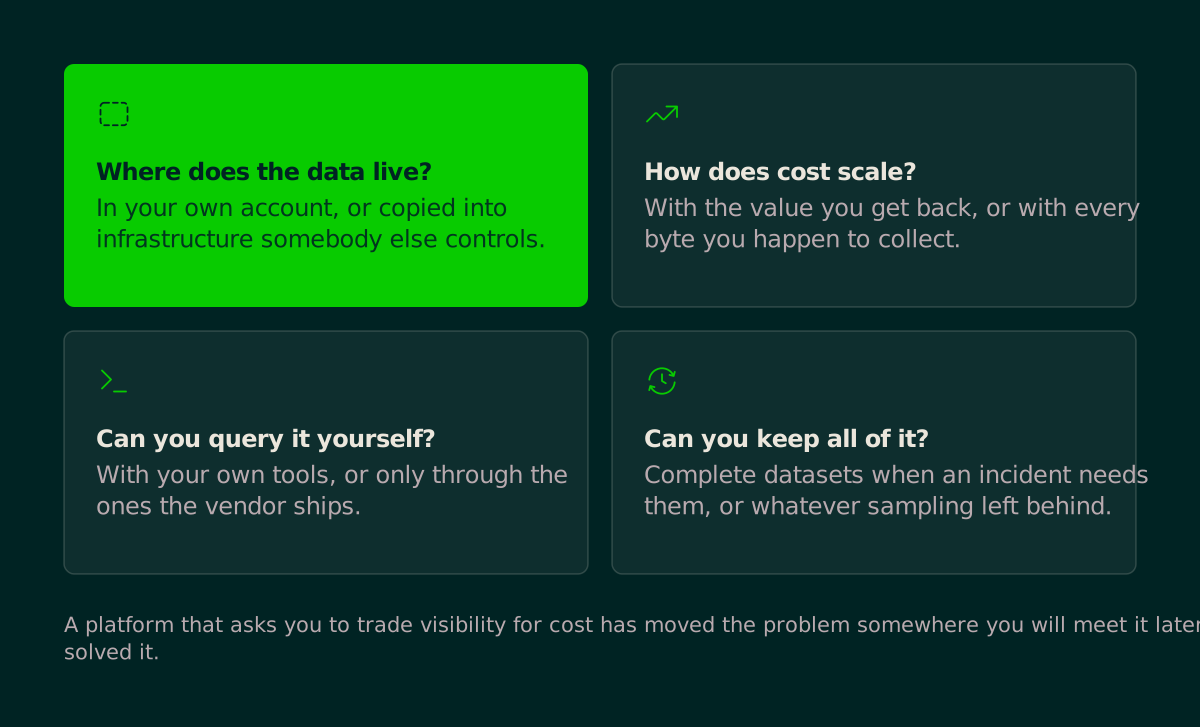
Those four questions get to the heart of it. A platform that requires you to give up visibility in order to control cost has not solved the problem, it has moved the trade-off somewhere you will meet it later, and the architectures that do solve it are the ones that separate visibility from cost growth so that systems can grow without the observability bill growing at the same rate.
Where Tsuga fits
Most observability platforms were built around a model where customers continuously send more data into vendor-controlled infrastructure, which works well for the vendor and less well for the customer. We took a different view of it.
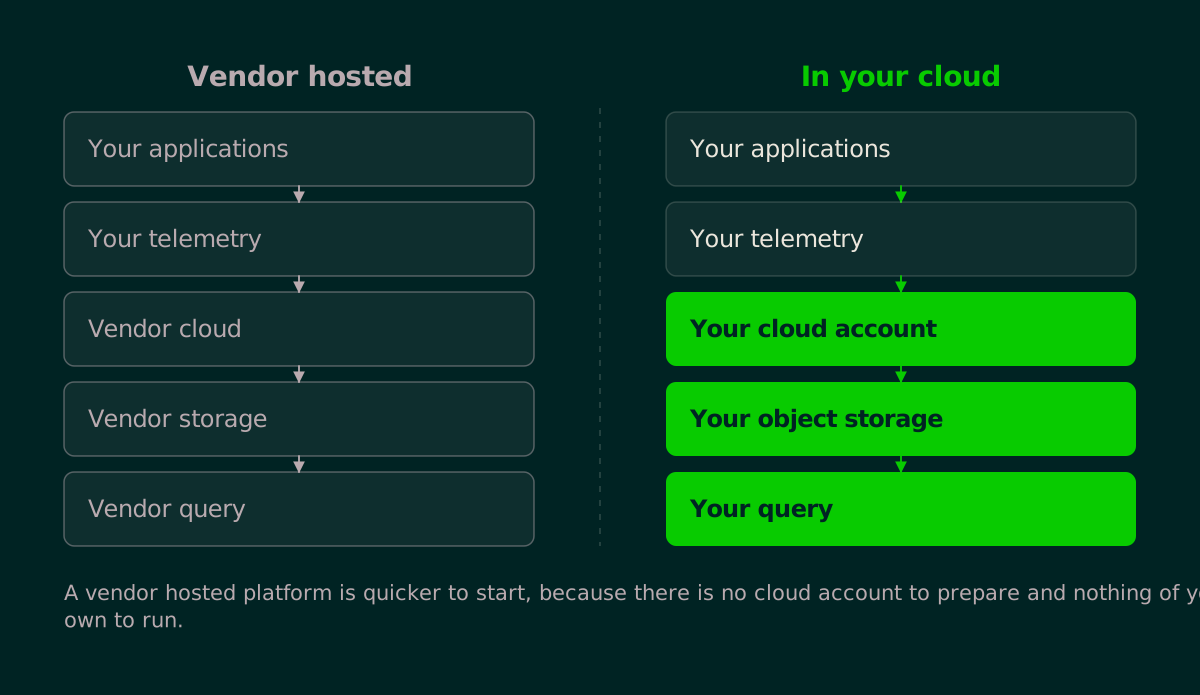
Ownership rather than dependency
We run on a Bring Your Own Cloud architecture, so instead of telemetry moving into our infrastructure, the platform runs inside yours. Your data never leaves your environment, which is an architectural property rather than a contractual promise, and you keep your storage, your retention policies and your cloud regions along with it. Observability stops depending on a vendor's ability to monetize your growth.
The cost consequence is direct. Storage and compute land on your own cloud bill at your provider's rates, with no markup on infrastructure you already own, so the second invoice that used to shadow the first simply is not there.
No duplicate storage, and the egress meter mostly stops
Paying to store operational data in your own cloud and then paying again to store the same data in a SaaS platform is the duplication described above, and there is no duplication into a vendor cloud when the platform runs where the data already is. Egress costs largely disappear for the same reason, because the data stops traveling. Your telemetry stays in your own object storage, your retention policies stay yours, and your teams reach the data without going through proprietary storage or vendor-controlled APIs.
Cost control that does not cost you visibility
The industry has normalized a trade-off that should not exist, where you either keep your telemetry and accept escalating costs or cut costs by sampling, filtering and shortening retention. We reject the premise, because the purpose of observability is to investigate behavior nobody predicted, and the moment the relevant data has been discarded the platform cannot do its job.
Removing the structural cost drivers that force sampling is what lets teams keep richer telemetry without watching the bill, and the aim is not simply to spend less. It is to spend less and see more.
Related terms
- BYOCBYOC, Bring Your Own Cloud, is a deployment model where a vendor's software runs inside the customer's own cloud account, operated by the vendor but living on infrastructure the customer owns.
- CardinalityCardinality is the number of distinct values, or distinct value combinations, that an attribute or set of attributes can take.
- Egress costsEgress costs are the fees cloud providers charge for data leaving their network, priced per gigabyte and varying by destination.
- MTTRMTTR is mean time to resolution, the average elapsed time from a failure occurring to service being restored.
- ObservabilityObservability is the ability to understand what is happening inside a system from the data it emits: its logs, metrics, and traces.
- SamplingSampling is the practice of keeping only a subset of telemetry, usually traces, so that volume and cost stay manageable.
- Vendor lock-inVendor lock-in is the accumulation of switching costs that makes leaving a platform impractical regardless of how the relationship is going: proprietary instrumentation, captive data, workflows that exist in only one tool, and contracts priced to reward staying.