From policing to performance: a modern governance model for observability
Nils Bunge
Learn how central platform teams can move from manual oversight to scalable observability governance, with clear cost attribution, automated compliance, and actionable maturity insights.
As observability adoption grows across an organization, something predictable happens. The central platform team, originally focused on building and improving the platform, finds itself spending more and more time on manual oversight. Chasing teams for missing tags. Investigating unexpected cost spikes. Trying to understand which services are sending what, and who is responsible for them.
Governance becomes a full-time job, and not a particularly satisfying one.
The problem is not that teams behave badly. It is that the tools available to central teams rarely give them the visibility they need to govern effectively. Without that visibility, governance becomes reactive. Platform teams police rather than guide, and product teams experience governance as friction rather than support.
The questions that should have clear answers
There are a handful of questions that any central observability team needs to be able to answer.
What telemetry is actually entering the platform?
Which teams own it?
Are those teams getting real value from it, or generating data that sits unread?
Where would targeted support have the most impact?
When these questions are hard to answer, the consequences compound. Cost attribution becomes a difficult conversation. Tagging conventions drift. Teams that would benefit from better observability practices do not get the guidance they need, because the platform team has no clear signal about where to focus.
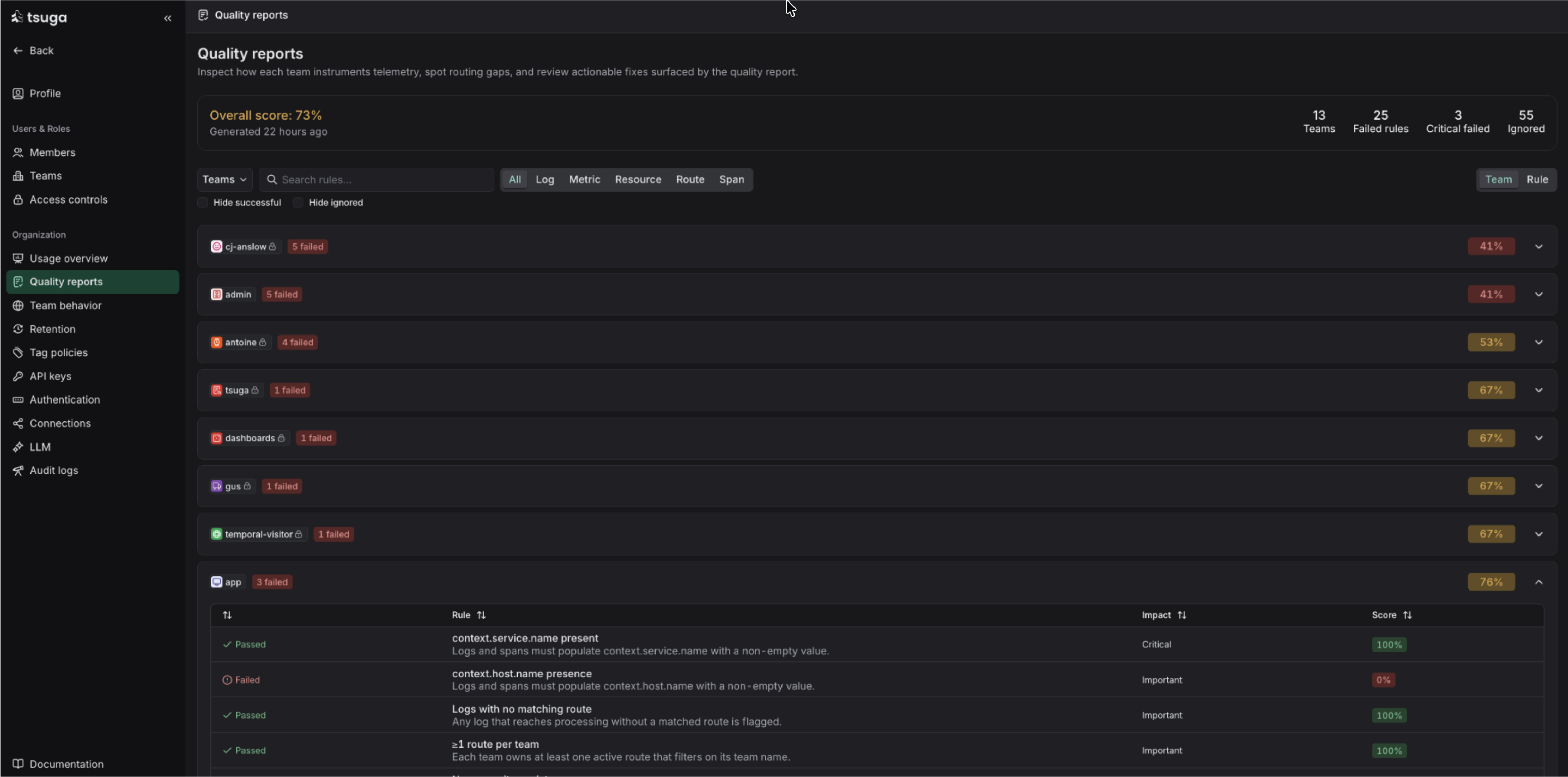
The underlying issue is architectural. Governance that depends on manual investigation cannot scale. It needs to be built into the platform itself.
Governance that enables rather than constrains
The shift worth making is from governance as a control mechanism to governance as a service the platform provides. That means giving central teams the transparency and automation they need to guide the organization, without creating friction for the product teams building on top of it.
Cost attribution is a good example. When every signal entering the platform carries the right ownership metadata automatically, chargeback conversations become straightforward. Teams can see their own usage clearly. Central teams can identify where optimisation is needed without having to investigate manually.
The same principle applies to tagging and compliance. Defining policies once and applying them consistently across the platform is more effective than asking teams to self-enforce conventions. And policies can be introduced progressively: measure compliance first, then introduce guidance, then apply stronger controls where they are genuinely needed. Teams are encouraged toward best practices rather than penalized for gaps they may not have known existed.
Understanding whether observability is actually working
Beyond cost and compliance, there is a harder question: is observability delivering value? Sending telemetry is not the same as using it well. Some teams generate significant data volumes without actively analysing them. Others may not realize which capabilities are available to them.
Visibility into platform usage patterns changes what central teams can do. Rather than applying broad governance measures across the organization, they can identify specifically where support would have the greatest impact, and direct their efforts there. Maturity reporting across telemetry quality, observability setup, and actual platform usage gives a clear picture of where improvements will generate the most value.
Retention is another area where real data changes the conversation. Policies are often set based on assumptions about how far back teams need to look. When actual query patterns are visible, retention decisions can be grounded in how the platform is genuinely used rather than theoretical requirements.
Governance as a foundation for scale
The organizations that scale observability successfully are not the ones that enforce the most rules. They are the ones that make good observability practices easy to follow and give teams the feedback they need to improve. Central teams that spend their time guiding and enabling rather than chasing and policing tend to build platforms that product teams trust and invest in.
That requires governance to be embedded in the platform from the start, not bolted on as adoption grows. If you are thinking about how to build an observability practice that scales with your organization, we would like to show you how Tsuga approaches it. Get in touch.