Lexicon · Guide
AI observability in your own cloud
AI observability for models, agents, token spend and inference infrastructure, with every prompt and trace kept encrypted inside your own cloud account.
What AI observability covers
AI observability helps your team understand how models, agents, applications and infrastructure behave in production. It connects each AI interaction with the systems involved in delivering it. A slow or failed response may begin with a model call, a tool, a database, an API or an overloaded GPU, and seeing the full path lets your engineers find the source without piecing together data from separate systems.
Model and agent telemetry: Follow model calls, agent steps, tool use, retries, failures and execution paths.
Prompts and completions: Inspect inputs, outputs, response times, model versions and the context attached to each request.
Token spend: Track input and output tokens by model, application, agent, team or environment.
Inference infrastructure: Monitor GPU utilization, memory, compute demand, saturation, inference latency and infrastructure errors.
We bring these signals together inside your cloud, so your team can investigate AI behavior with the system context behind it. If you are working with large language models (LLMs) specifically, our LLM observability guide goes deeper on what to capture.
What Tsuga deploys inside your cloud account
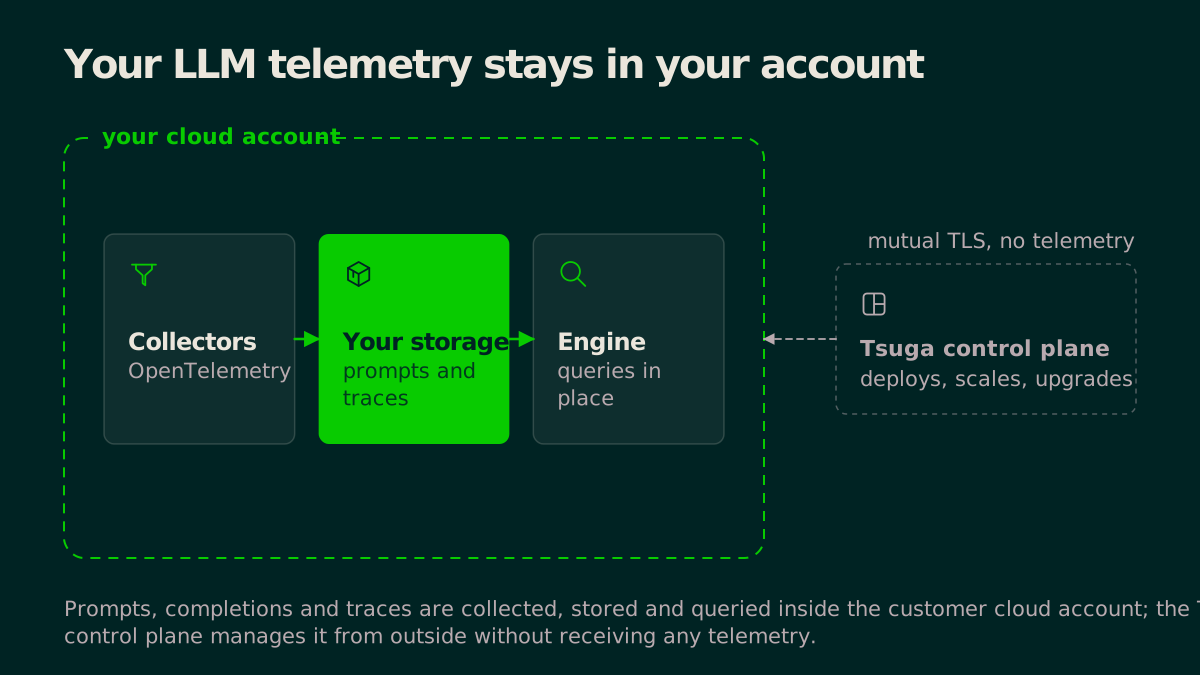
We deploy the Tsuga observability data plane inside your AWS, Azure or Google Cloud account through infrastructure as code, typically in under two hours. The figure below shows where each part runs and what crosses the boundary.
Your infrastructure and data
Compute runs in your account, and telemetry stays in your object storage, encrypted by your own key management service. Storage and compute charges appear directly on your own cloud bill, at your provider's rates.
A lifecycle managed by Tsuga
We handle deployment, upgrades, autoscaling, recovery and resilience during heavy query loads. Our hosted control plane connects through mutual TLS for remote management, and it does not ingest or store your telemetry. You keep physical and legal control of the data while we take care of running the platform.
Related terms
- BYOCBYOC, Bring Your Own Cloud, is a deployment model where a vendor's software runs inside the customer's own cloud account, operated by the vendor but living on infrastructure the customer owns.
- CardinalityCardinality is the number of distinct values, or distinct value combinations, that an attribute or set of attributes can take.
- Data residencyData residency is the question of where data physically lives: which country or region stores it, and where it is processed along the way.
- LLM observability explained: how to monitor performance, quality and costLLM observability tells you whether your AI application is fast, reliable, useful and affordable in production, which uptime and error rates alone cannot.
- OpenTelemetryOpenTelemetry is an open source framework for generating, collecting, and exporting telemetry: the logs, metrics, and traces that describe how software behaves in production.
- We reviewed 10 reliable LLM observability tools for production teams in 2026The top LLM observability tools are Tsuga, Langfuse, LangSmith, Datadog, Arize Phoenix, Helicone, W&B Weave, Braintrust, Dynatrace and HoneyHive.